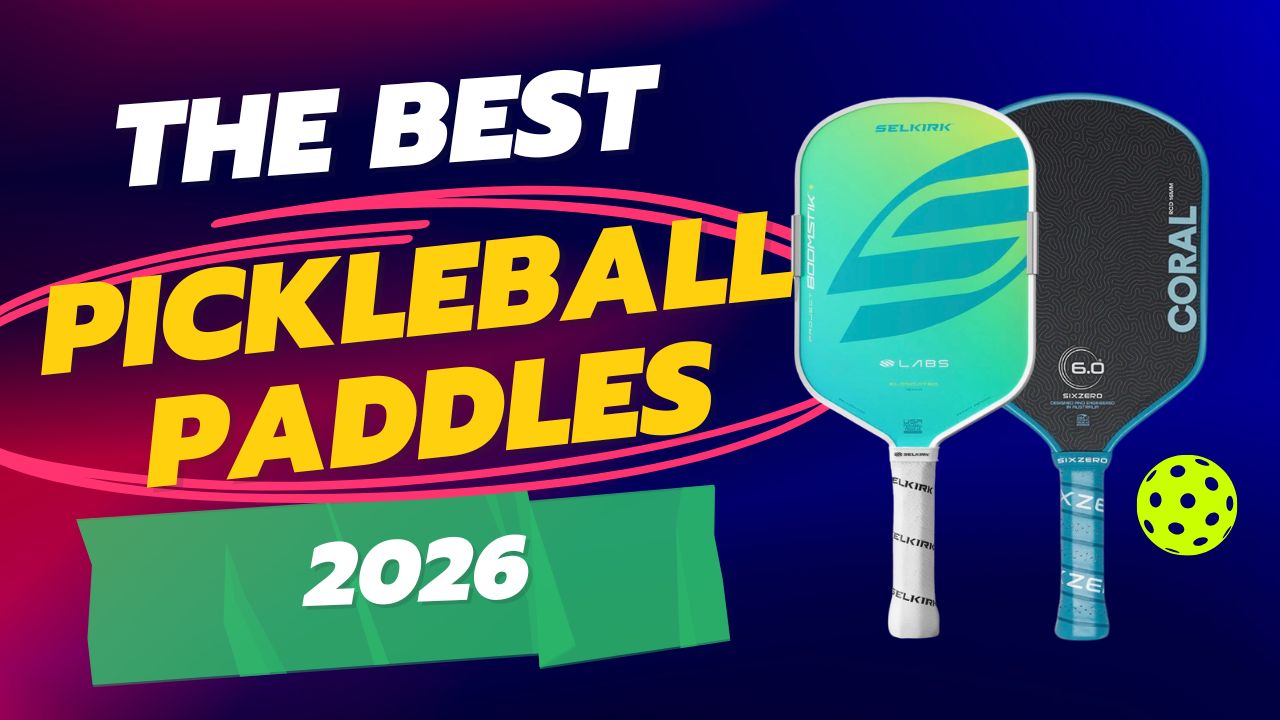
Best Pickleball Paddles for 2026: Our Top Picks
If you are looking for a new pickleball paddle in 2026, there are probably more choices than ever before. There are also a lot more expensive paddles than there were just a few years ago.
Paddle technology has changed quite a bit since we put together our original list of the best pickleball paddles in 2023. Foam cores have become much more common, manufacturers are experimenting with different shapes and materials, and $250-$300+ paddles are no longer unusual.
That does not mean you need to spend $300 to get a good paddle.
For this list, we looked at paddles across several different price ranges and tried to focus on what actually matters for recreational and league players: feel, control, power, sweet spot, handle length, paddle shape and, of course, price.
There also isn’t one paddle that is going to be “best” for everybody. A beginner looking to upgrade from a cheap starter set probably shouldn’t be shopping for the same paddle as a 4.5 player who wants as much power as possible.
So rather than trying to name one winner, we broke our favorites down by the type of player they make the most sense for.
We also paid much closer attention to paddle approval this year. USA Pickleball and UPA-A approvals have become increasingly confusing, and the exact version of a paddle now matters if you plan to play sanctioned tournaments.
Here are our favorite pickleball paddles for 2026.
Jump to a pick
- Best for Beginners
- Best Value Around $100
- Best for Control
- Best All-Court
- Best for Power
- Best for a Two-Handed Backhand
Our Top Pickleball Paddles for 2026
- Best Pickleball Paddle for Beginners: 11SIX24 Pegasus Jelly Bean 16mm
- Best Value Pickleball Paddle Around $100: Vatic Pro V-SOL Pro 16mm
- Best Pickleball Paddle for Control: Selkirk LUXX Control Air
- Best All-Court Pickleball Paddle: Six Zero Coral Pro Hybrid 16mm
- Best Pickleball Paddle for Power: Holbrook Fuze
- Best Pickleball Paddle for a Two-Handed Backhand: Honolulu J2CR Extended Handle
Best Pickleball Paddle for Beginners
11SIX24 Pegasus Jelly Bean 16mm
The 11SIX24 Pegasus Jelly Bean is our favorite paddle for someone buying their first real pickleball paddle.
There are a couple of reasons for that, but the biggest is forgiveness.
The Pegasus is a widebody paddle measuring just over 8 inches across. That gives you a large hitting surface and a pretty forgiving sweet spot, which is exactly what I would want when moving on from one of the inexpensive paddles that came in a starter set.
The 16mm core also helps keep the paddle relatively controlled. Newer players usually don’t need a paddle designed to launch the ball off the face. Keeping your drops, dinks and returns in the court is probably going to help your game quite a bit more than adding another few miles per hour to your drive.
I also really like the handle.
At 5.75 inches, it is unusually long for a widebody paddle. That’s enough room for a two-handed backhand and makes the paddle especially interesting for newer players coming over from tennis.
The Pegasus weighs approximately 8.0-8.3 ounces with a swing weight around 109-111, so it should still move quickly enough during hands battles at the kitchen.
At roughly $100, this is also about as much as I think most beginners really need to spend.
There are absolutely better and more technologically advanced paddles available. I’m just not convinced a player who started playing pickleball three months ago needs a $300 paddle.
Why we like it: Large sweet spot, good control, long handle and a reasonable price.
Who should skip it: Players who already know they want an elongated paddle or considerably more power.
Key Specs
- Core: 16mm
- Shape: Widebody
- Weight: 8.0-8.3 oz
- Handle Length: 5.75 inches
- Swing Weight: 109-111
- USA Pickleball Approved: Yes
- Price: About $100
Also consider: The SLK Valkyrie Widebody is another forgiving beginner option if you want to stay closer to the $80 range.
Best Value Pickleball Paddle Around $100
Vatic Pro V-SOL Pro 16mm
This was probably the biggest change we made to this year’s list.
There are a surprising number of good pickleball paddles available around $100 now, but the Vatic Pro V-SOL Pro stands out because you are getting technology that would have been found almost exclusively in much more expensive paddles not very long ago.
The V-SOL uses a full EPP foam core with an EVA foam perimeter rather than a traditional polypropylene honeycomb core.
More importantly, it manages to add power and pop without turning into a paddle that is difficult for the average recreational player to control.
That’s what makes it interesting to me.
There are cheaper control paddles. There are also much more expensive foam paddles that generate more power. The V-SOL falls somewhere in the middle and gives you a chance to try modern foam paddle technology without spending $200-$300.
It is also available in different shapes, which makes this recommendation a little easier. Someone who prefers an elongated paddle doesn’t necessarily have to buy the exact same shape as a doubles player looking for more forgiveness.
The regular price is currently around $110, although $10 manufacturer and reviewer discount codes are commonly available that bring it to roughly $100.
That’s why I’m calling this our best value around $100 rather than pretending it is always a sub-$100 paddle.
For a player who has been using a traditional polymer paddle and wants to see what all the attention around foam is about, this is probably where I would start.
Why we like it: Modern foam construction, good power-to-control balance and excellent value.
Who should skip it: Players who want a very soft traditional control paddle or who simply don’t need the additional pop of foam.
Key Specs
- Core: 16mm EPP foam with EVA perimeter
- Weight: Approximately 8.0-8.3 oz
- USA Pickleball Approved: Yes
- Price: About $110 retail; commonly around $100 with a discount code
Also consider: The Vatic Pro Prism Flash remains one of the better traditional control paddles around $100 and might actually be the better choice if you prefer a softer feel.
Best Pickleball Paddle for Control
Selkirk LUXX Control Air with InfiniGrit
There are newer control paddles available in 2026, and some of them cost considerably less.
I’m still putting the Selkirk LUXX Control Air here.
The reason is pretty simple: if the question is pure control, rather than which paddle gives you the best combination of control and power, the LUXX is still really good at what it was designed to do.
The current LUXX Control Air with InfiniGrit uses a very thick 19mm honeycomb core. Compared with many of the newer foam paddles, it has a softer and more predictable feel that works particularly well on drops, resets and dinks.
If you are someone who already generates plenty of your own power but constantly feels like your third-shot drops are carrying too far or your resets are popping up, this is the type of paddle I would be looking at.
The newer InfiniGrit version also addresses one of the complaints with the original LUXX by giving the surface more durable spin characteristics.
There are some obvious drawbacks.
First is price. Even with Selkirk currently discounting the paddle from its original price, you can buy some very good control paddles for half as much.
The 5.25-inch handle on the Epic is also not going to be my first choice for somebody who regularly hits a two-handed backhand.
And if you want a paddle that gives you free power on serves and drives, this isn’t why you buy the LUXX.
I think that distinction is important.
A lot of paddles labeled “control” in 2026 are really all-court paddles with good control. The LUXX still feels like a paddle made specifically for someone who wants to slow the game down.
Why we like it: Excellent touch, predictable response and a genuinely control-oriented feel.
Who should skip it: Power players, value shoppers and players who need a long handle.
Key Specs — Epic
- Core: 19mm X7 honeycomb
- Face: Florek Carbon Fiber with InfiniGrit
- Weight: 7.9-8.3 oz
- Handle Length: 5.25 inches
- Swing Weight: Approximately 109
- USA Pickleball Approved: Yes
Also consider: The Vatic Pro Prism Flash is still a very good lower-priced option for pure control, while newer 11SIX24 Jelly Bean models offer a more modern take on the category.
Best All-Court Pickleball Paddle
Six Zero Coral Pro Hybrid 16mm
If you don’t consider yourself strictly a power player or a control player and simply want one paddle that can do a little bit of everything, the Six Zero Coral Pro Hybrid is probably my favorite option on this list.
The Coral Pro uses a 16mm foam-based Tectonic Core with Six Zero’s ProPulsion Foam and a hybrid shape.
We tend to like hybrid paddle shapes for all-court players because they sit somewhere between a widebody and an elongated paddle.
You get more reach than most widebody paddles without giving up as much forgiveness as you sometimes do with a long and narrow elongated shape.
The Coral Pro Hybrid measures 16.3 inches long, has a 5.5-inch handle and comes in around 8.0-8.3 ounces. Its swing weight is listed around 114.
That makes it substantial enough to generate pace without feeling like you are swinging one of the heavier elongated power paddles on every shot.
What I like most about the Coral Pro is that you don’t have to build your entire game around one strength to justify buying it.
If you hit third-shot drives sometimes and drops other times, play a lot of doubles, want good spin and still need enough forgiveness when you don’t hit the center of the face, this checks a lot of boxes.
There are paddles with more raw power.
There are paddles with softer control.
But most players don’t spend an entire match doing one thing.
That’s why I like the Coral Pro as an all-court choice.
One important caveat: Six Zero currently lists the Coral Pro with UPA registration. If you play sanctioned tournaments, make sure the exact paddle and event approval requirements work for you before purchasing.
Why we like it: Excellent balance of power, control, spin, reach and forgiveness.
Who should skip it: Players looking specifically for maximum power or players who require a particular tournament approval.
Key Specs — Hybrid
- Core: 16mm Tectonic Core with ProPulsion Foam
- Shape: Hybrid
- Weight: 8.0-8.3 oz
- Handle Length: 5.5 inches
- Swing Weight: Approximately 114
- Registered Approval Body: UPA
- Price: Check current pricing
Also consider: The Honolulu J2CR belongs in this conversation as well. If someone told me they preferred the J2CR to the Coral Pro as an all-court paddle, I wouldn’t argue very hard.
Best Pickleball Paddle for Power
Holbrook Fuze
The power category is probably the one that has changed the most since our original 2026 list.
The Selkirk Boomstik is still an extremely powerful paddle, but there are now enough newer options that I don’t think it automatically deserves the category anymore.
Our current pick is the Holbrook Fuze.
The Fuze uses a full foam core with what Holbrook calls its Dual Density Core. Higher-density foam is placed toward the upper portion of the paddle, while lower-density foam is used closer to the center.
You don’t really need to care about the marketing name.
What matters is that the paddle is designed to provide a lot of power without making the entire face feel uncontrollable when you aren’t swinging hard.
The elongated 16mm version weighs approximately 7.8-8.0 ounces but has a swing weight around 117-118. That combination should give players plenty of leverage on serves and drives without requiring an unusually heavy static paddle.
It also has a 5.5-inch handle, which is enough for many two-handed backhand players, although I prefer a little more room if that is a major part of your game.
The Fuze isn’t cheap at around $230.
But that’s still meaningfully less than something like the Boomstik, and I think that’s part of the reason it makes more sense as our primary power recommendation.
You’re getting a modern foam paddle with plenty of offense, but you aren’t quite into the $300+ territory.
If you mostly play soft doubles at the kitchen and don’t have trouble generating pace, you probably don’t need this paddle.
If you like attacking serves, driving third shots and putting balls away when they sit up, the Fuze makes much more sense.
Why we like it: Lots of power without completely sacrificing forgiveness or touch.
Who should skip it: Players who prioritize soft control or who dislike higher-swing-weight paddles.
Key Specs — Elongated 16mm
- Core: Dual Density full foam
- Face: Carbon-Aramid-Carbon
- Thickness: 16mm
- Weight: 7.8-8.0 oz
- Handle Length: 5.5 inches
- Swing Weight: Approximately 117-118
- USA Pickleball Approved: Yes
- Price: About $230
Also consider: The Selkirk Labs Boomstik is still one of the hardest-hitting premium paddles available and has an excellent long handle. Bread & Butter’s Loco and other newer foam paddles are also worth looking at if power is your main priority.
Best Pickleball Paddle for a Two-Handed Backhand
Honolulu J2CR Extended Handle
Anyone coming from tennis will probably understand why this category is here.
One of the things that still bothers me about some pickleball paddles is how short the handles are.
A 5.25-inch grip may be completely fine for somebody hitting a traditional one-handed backhand. Put a second hand on there and things start getting crowded quickly.
That’s why I like the extended-handle version of the Honolulu J2CR.
Honolulu offers the J2CR with its original 5.5-inch handle or an extended 6-inch handle.
Six inches is a lot of room by pickleball standards and makes this one of the more natural options I’ve seen for players who regularly use two hands.
The important part is that the rest of the paddle is also good.
I wouldn’t recommend a mediocre paddle simply because somebody made the handle longer.
The J2CR uses Honolulu’s hybrid-style shape and Core Reactor foam technology, giving it a combination of power, pop and control that also makes it a legitimate all-court paddle.
At around $195, it isn’t cheap, but it is also considerably less expensive than some of the premium paddles that offer similarly long grips.
There is one detail you need to pay attention to when ordering.
Honolulu specifically identifies the regular J2CR as the USAP-approved model and distinguishes it from the Crystal Blue version. If tournament approval matters to you, make sure you are buying the exact approved version rather than assuming every paddle carrying the J2CR name has identical status.
For a tennis player moving into pickleball or anyone who just feels cramped on a standard grip, the extended J2CR would be very high on my list.
Why we like it: Legitimately long 6-inch grip attached to a paddle that is also excellent everywhere else on the court.
Who should skip it: Players who prefer compact handles or don’t need the additional grip space.
Key Specs
- Core: Core Reactor foam construction
- Shape: Hybrid
- Handle Options: 5.5 inches or extended 6 inches
- USA Pickleball Approved: Regular J2CR model; verify the exact version
- Price: About $195
Also consider: The Selkirk Boomstik has a 5.8-inch handle and the Paddletek Honeyfoam TKO-X 16mm has a 5.75-inch handle. Both give two-handed players more room than the average paddle.
Other Pickleball Paddles Worth Considering in 2026
There are way too many good paddles available right now to pretend that six models are the only ones worth buying.
These are some of the others that would be on my shortlist.
Selkirk Labs Boomstik
Still one of the paddles I would look at if maximum power is the goal.
The elongated Boomstik combines a high swing weight with a 5.8-inch handle, making it especially interesting for aggressive players who use a two-handed backhand.
The problem is price.
At well over $300, I think the Holbrook Fuze and several other newer foam paddles make the value proposition harder than it used to be.
Vatic Pro Prism Flash 16mm
The Prism Flash has been around longer than most of the newer paddles on this list, but that isn’t necessarily a bad thing.
It remains a very good choice for players who want a softer, controlled feel without paying premium prices.
If you don’t particularly care whether your paddle has a foam core, I wouldn’t overlook it just because newer technology is getting more attention.
Bread & Butter Loco
The Loco belongs on the shortlist for players looking for power and modern foam construction.
There is a growing group of high-powered foam paddles competing in this part of the market, and the Loco is one of the ones I would compare against the Fuze and Boomstik before buying.
Paddletek Honeyfoam TKO-X 16mm
The Honeyfoam TKO-X is especially interesting for players who like elongated paddles.
Its 5.75-inch handle gives you good room for a two-handed backhand, and the elongated shape provides plenty of reach from the baseline.
As with any paddle where multiple thicknesses and versions exist, verify the exact approval status if you plan to use it in tournaments.
CRBN TruFoam Barrage
CRBN’s TruFoam paddles are another premium foam option worth considering.
The Barrage is aimed more toward aggressive players who want power from a full-foam construction.
The price puts it firmly in premium territory, so it makes more sense for someone who already knows what they want rather than a player buying their first serious paddle.
JOOLA Perseus Pro V 16mm
JOOLA remains one of the biggest names in pickleball equipment, and the Perseus Pro V is still worth considering for players who prefer an elongated shape.
Just be careful with JOOLA naming.
There have been enough different Perseus generations and approval issues over the last few years that I would always check the complete model name rather than assuming one Perseus is the same as another.
How to Choose a Pickleball Paddle
You can spend hours comparing pickleball paddle specifications.
For most recreational players, I think there are really five things worth paying attention to.
Paddle Shape
Paddle shape has a noticeable effect on how a paddle plays.
Widebody paddles generally give you a larger hitting area and a more forgiving sweet spot. I like them for beginners, doubles players and anyone who values consistency.
Elongated paddles give you additional reach and can create more leverage on serves and groundstrokes. The tradeoff is usually a smaller sweet spot and a little less maneuverability.
Hybrid paddles fall somewhere between the two.
If you aren’t sure what you like yet, a hybrid is probably the safest place to start.
Coming from tennis, I personally tend to prefer hybrid and elongated paddles because they feel a little more natural on groundstrokes and usually provide more room for a two-handed backhand.
Core Thickness
For most recreational players, 16mm is still a very good starting point.
Thicker paddles generally feel softer and more controlled.
The 19mm LUXX is an extreme example of that and works particularly well for players who want help taking pace off the ball.
Thinner 14mm paddles generally feel firmer and can provide additional pop.
That doesn’t mean a 14mm paddle is automatically better.
If your biggest problem is hitting drives long and popping up resets, adding more pop may be the exact opposite of what you need.
Foam vs. Polymer Cores
Foam is probably the biggest paddle trend in 2026.
There are some excellent foam paddles.
There are also excellent polymer honeycomb paddles.
I would not buy a paddle simply because the box says “foam.”
Full-foam and foam-assisted constructions can give paddles a different combination of power, pop, sweet spot and feel, but implementation varies quite a bit from one manufacturer to another.
The V-SOL doesn’t feel exactly like the Coral Pro, and the Coral Pro doesn’t feel exactly like the Fuze just because all three use foam somewhere in the construction.
Start with what you want the paddle to do.
Then worry about how the manufacturer built it.
Handle Length
Handle length gets overlooked all the time.
If you use a one-handed backhand, a shorter grip may never bother you.
If you hit a two-handed backhand, it can make a huge difference.
Personally, I would look for at least 5.5 inches if you use two hands regularly.
Something around 5.75 inches is even better, and the 6-inch J2CR Extended Handle gives you about as much room as you are likely to need.
Weight and Swing Weight
Most paddles on this list weigh somewhere around 8 ounces.
That doesn’t mean they all feel the same.
Swing weight tells you more about how heavy the paddle feels while you are actually swinging it.
An elongated paddle with more mass toward the end of the paddle can generate excellent power but may feel noticeably slower during quick exchanges at the kitchen.
This is also something I would pay attention to if you have had elbow or shoulder problems.
More swing weight isn’t automatically better.
Price
This might be the easiest specification to overthink.
A $300 paddle is not three times better than a $100 paddle.
There are legitimate reasons some premium paddles cost more, particularly as manufacturers experiment with new cores, surface materials and construction techniques.
But the gap between budget and premium paddles has gotten much smaller.
For beginners, I would probably stay around $80-$120.
Once you have played enough to know that you specifically want more power, a longer handle, a different shape or a certain type of feel, spending $200+ becomes easier to justify.
What Is the Best Pickleball Paddle for Beginners?
Our pick for 2026 is the 11SIX24 Pegasus Jelly Bean 16mm.
The combination of a widebody shape, forgiving sweet spot, 16mm core and unusually long 5.75-inch handle makes it easy to recommend to newer recreational players.
At roughly $100, it also leaves you with some money for lessons or court time instead of spending $300 on your first paddle.
What Is the Best Pickleball Paddle for the Money?
Around the $100 price point, we like the Vatic Pro V-SOL Pro.
It brings modern foam-core construction into a price range that used to be dominated by traditional polymer paddles.
The regular direct price is slightly over $100, although discount codes commonly bring it to roughly $100.
If you care more about control than foam technology, the Vatic Prism Flash is another paddle we would look at.
What Is the Best Pickleball Paddle for Control?
We still like the Selkirk LUXX Control Air for players who specifically prioritize touch, resets and dinks over power.
There are newer and cheaper alternatives, but the thick 19mm core gives the LUXX a distinctly control-oriented feel.
What Is the Best Pickleball Paddle for Power?
Our current pick is the Holbrook Fuze.
The elongated 16mm version combines a full foam core with a swing weight around 117-118 and provides plenty of power on serves and drives.
The Selkirk Boomstik remains one of the more powerful premium alternatives if price isn’t an issue.
What Pickleball Paddle Is Best for a Two-Handed Backhand?
Start by looking at handle length.
Our favorite is the extended-handle Honolulu J2CR because Honolulu offers it with a full 6-inch grip.
The Boomstik at 5.8 inches and Paddletek Honeyfoam TKO-X at 5.75 inches are other options worth considering.
For players who regularly hit a two-handed backhand, I generally wouldn’t want to go much shorter than 5.5 inches.
Is a 14mm or 16mm Pickleball Paddle Better?
Neither is automatically better.
For most recreational players, I think 16mm is the safer place to start.
A 16mm paddle generally offers a little more control and a softer feel, while 14mm paddles tend to feel firmer and provide additional pop.
Your playing style matters considerably more than which number is newer or more popular.
Do You Need a Foam Pickleball Paddle in 2026?
No.
Foam is popular and there are some really good foam paddles available right now.
Traditional polymer paddles did not suddenly stop working.
If you already like the feel and consistency of a polymer paddle, there is no reason you need to replace it simply because manufacturers have moved on to another technology cycle.
If you want more pop, a different feel or simply want to try the newer technology, paddles like the V-SOL make that much more affordable than it was a couple of years ago.
USA Pickleball vs. UPA-A Paddle Approval
This is probably the least exciting part of buying a paddle in 2026, but it may be one of the most important if you play tournaments.
USA Pickleball and UPA-A maintain separate paddle approval systems.
That means you should not automatically assume that a paddle approved by one organization is approved by the other.
Different versions of what sounds like the same paddle may also have different approval status.
The Honolulu J2CR is a good example. Honolulu specifically identifies its regular J2CR as the USAP-approved version and distinguishes it from the Crystal Blue model.
Six Zero currently lists the Coral Pro under UPA registration.
If you only play recreational pickleball at your local courts, this may never matter.
If you enter sanctioned events, it matters a lot.
Before buying an expensive paddle for tournament play, search the exact manufacturer, model, thickness and version on the governing body’s current approved-equipment list.
Don’t rely on an old review, Amazon listing or even this article six months from now. Paddle approval has been changing too quickly.
Final Thoughts
There has probably never been a better time to buy a pickleball paddle.
There has also probably never been a more confusing time to buy one.
Manufacturers are releasing new cores, surfaces and paddle generations constantly, and it is easy to feel like the $250 paddle you bought six months ago has somehow become outdated.
It probably hasn’t.
For most recreational players, I would worry much more about paddle shape, forgiveness, handle length and whether you prefer power or control than which generation of foam is currently getting talked about online.
If you are buying your first serious paddle, the 11SIX24 Pegasus Jelly Bean gives you a lot for around $100.
If you want to try newer foam technology without spending $200+, I like the Vatic V-SOL Pro.
For all-court players, the Six Zero Coral Pro is probably the paddle on this list that checks the most boxes.
Players who want more power should look at the Holbrook Fuze, while someone prioritizing soft-game control may still be happier with the Selkirk LUXX.
And for tennis players like me who don’t want to cram two hands onto a tiny pickleball grip, the 6-inch Honolulu J2CR is particularly interesting.
I would still demo a few paddles if you can.
Specs help narrow the choices, but how a paddle actually feels in your hand is still more important than whether somebody on the internet ranked it first or fifth.